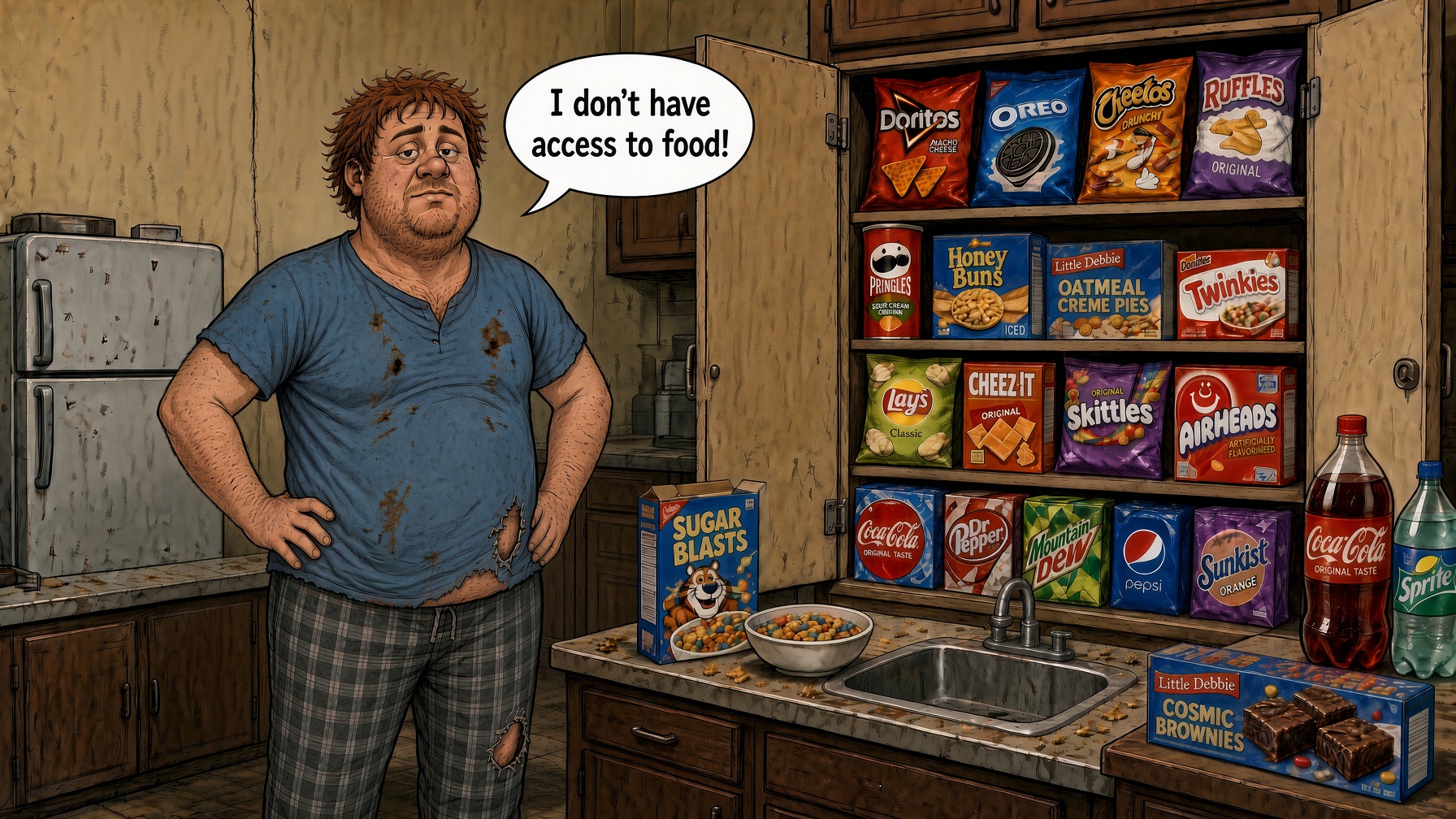
For more than two decades, liberal activists have insisted that “food deserts” in urban neighborhoods are a primary driver of health disparities between lower and higher-income Americans.
We have all heard the story: residents of low-income city areas supposedly lack access to nearby supermarkets stocked with fresh produce, forcing them into diets of fast food and convenience store junk. Billions in grants and tax incentive programs have followed.
The data tells a different story.
A study published in the Quarterly Journal of Economics found that local supermarket access explains only about 9 percent of the nutritional gap between higher and lower-income households.
The remaining 91 percent is driven by differences in what people prefer to buy when the same options are available. New supermarket openings in so-called “food deserts” produce little measurable improvement in the healthfulness of what residents actually purchase.
Households in low-income areas already buy the large majority of their groceries from supermarkets, traveling several miles, similar to higher-income shoppers. On average, low-income shoppers and high-income shoppers travel the exact same distance to buy their groceries.
The activist will quickly respond to this fact by pointing out that fewer people in low-income areas own a car, which makes buying their groceries more troublesome. They need to ride the bus! They don’t have access!
Of course, that’s true. Spending an hour on the city bus compared to 20 minutes in your car to accomplish the same task is one of the many pitfalls of being poor.
But this only goes to show that the word “access”, much like so many words in the liberal lexicon, has lost all meaning.
The word they should be searching for is “convenience”, but as the NBER study demonstrates, making a grocery store more convenient does very little to impact overall health.
Today, physical proximity to a grocery store in an urban environment means less than it ever has.
Walmart accepts SNAP/EBT for online grocery orders, and Walmart+ members get free delivery on orders of $35 or more. SNAP recipients and others on government assistance qualify for a discounted rate of roughly half price (about $6.47 per month).
Instacart also accepts SNAP/EBT for grocery orders.
In Springfield, we have lately been hearing more about the urban “food desert” with the impending opening of 7’s Groceries on Clear Lake Ave. Activists are celebrating the elimination of a “food desert” and greater “access” to fresh food for the residents of nearby neighborhoods.
Nobody living within walking distance to 7’s Groceries is lacking access to fresh food. They can get it delivered directly to their front door for as little as $6.47 per month. If they aren’t eating fresh food today, it’s because they don’t want to.
For anyone with basic internet access through a cell phone, the physical proximity to a supermarket is not a barrier to fresh food in an urban environment. The urban “food desert” is a complete and total myth.
However, food deserts still do exist today in our country, but they are located in the one place that liberal activists couldn’t care less about – rural white America.
In parts of the Midwest, Appalachia, and the rural South, the nearest full supermarket can be 15 to 30 miles away.
That’s a food desert.
But nobody cares.